Fans and follow-up
Get the next date into their phone before they leave the room
People who enjoyed tonight's set forget your name by Tuesday. How to put your next gig in their calendar before they go, and bring them back next time.
Read
Learn how to turn passing foot traffic into real fans with simple busking signs, filming, social links and a follow-up system that works.
By GigTag9 min read
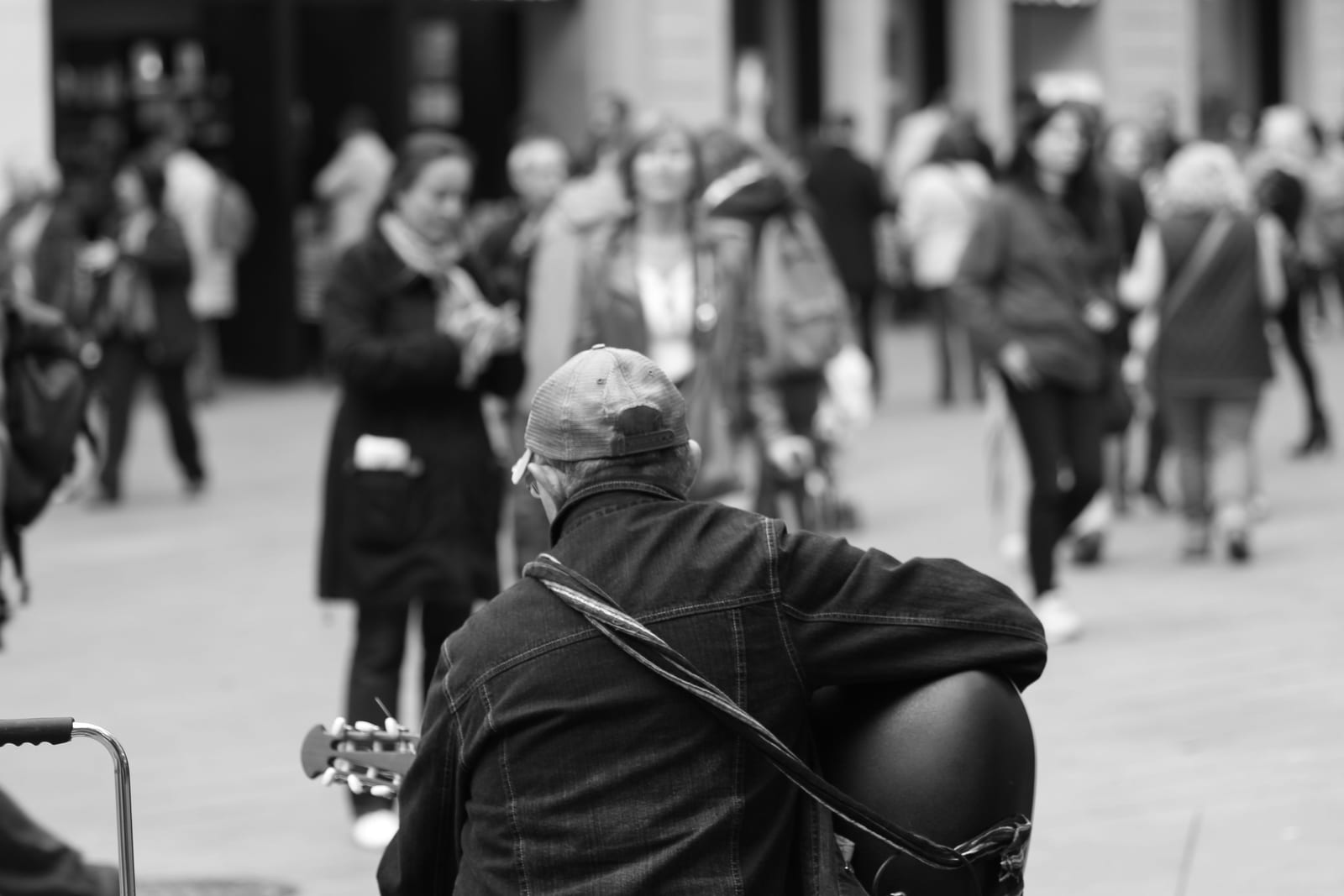
You can play a good set and still lose the room the moment people walk on. That is the problem with busking, the music stops, the crowd moves, and most of them are gone before you have said your name. If you are learning how to promote yourself as a busker, the job is not only to stop people for a song, it is to make it easy for them to find you again before they leave.
A stranger who likes one song will not build a memory around your whole career. They will act on the easiest next step. So your job is to give them one clear action that works while they are still standing there.
That usually means three things in the same place: your name, your social handles, and a simple follow link or QR code. Keep it close to where people naturally look, on the case, the stand, or a small sign beside you. Do not make them hunt.
Think of the sign as part of the performance, not a separate bit of marketing. It should answer the basic questions fast:
If you make that obvious, people do not need a long explanation. They can scan, follow, and leave with a reason to come back.
For many working performers, the best follow-up is a page that opens instantly on a phone and shows the important links in one place. GigTag does this with a QR code that opens your act page, but the principle matters even if you use something else: one tap should lead to your socials, your next gig, and a way to keep in touch.
The most common busking mistake is a beautiful set-up with no readable name. People hear you, maybe film you, then later they cannot remember who you were. They remember the street, the weather, maybe the song. They do not remember the handle.
Make your name large. Use the same spelling everywhere. If your artist name is different from your personal name, only use the artist name on the sign. Consistency is what helps a stranger search you later.
Your sign should include:
Do not cram in every platform you have ever joined. A long list looks busy and gets ignored. If you try to be everywhere at once, you often end up being nowhere clearly.
Keep the design readable in daylight and under street lights. High contrast works. So does a clean layout with enough space around the code. If people have to zoom in before they scan, you have already made the job harder than it needs to be.
For placement ideas, see where to put a QR code as a musician. That guide is useful whether you are busking outside a café, playing a promenade, or standing by a hotel terrace.
A loose flyer gets lost. A tag on the case stays with you. It travels with the instrument, and it is there every time you play. That matters, because busking is repeat work. You set up, play, pack down, and move on. The best promotion tool is the one that is already with you.
If the sign lives on the case, it becomes part of your routine. You do not forget it in the car. You do not arrive and realise the printout is still on the kitchen table. You also make it easier for someone to photograph you mid-set and capture your name in the frame.
A good setup usually has:
That does not mean the sign has to be fancy. It just has to be clear. People walking past have a fraction of a second to decide whether to keep going or stop. Clear wins.
If you busk regularly, you should assume some of your best listeners are not the ones standing in front of you. They are the people who walked past, heard the chorus, and later saw a clip online. That is why filming matters.
You do not need a crew. You need short clips that show what it feels like to stop for one song. Film the parts people actually share, a strong opening line, a chorus, a smile from the small crowd, the moment someone pauses with a coffee in hand. Keep the camera steady if you can, and do not over-edit.
Useful clips for a busker are simple:
Post the clip the same day if possible. If not, save it with a clear filename so you can use it later. Add the same name and handle you used on the sign. If someone sees the video on the train home, they should be able to find you in one search.
Do not rely on the video alone, though. People often watch with sound off, or forget later. The point of the clip is to reinforce the name they already saw on the sign.
The easiest follow-up is not a wall of links. It is one page that does the sorting for them. If your sign points to a page with your Instagram, TikTok, Spotify, YouTube, website, and next gig, people can pick the path they actually use.
That matters because passers-by are not all the same. Some want to follow on social media. Some want a calendar reminder for your next show. Some just want to save your name so they can search you later. One clean page handles all of that.
If you are using a page link, make the button text plain:
Avoid vague labels. “Visit my universe” is not useful. The person who heard you for one song wants something obvious. Tell them what happens when they tap.
This is also where a simple live-music page helps with follow-up after the street set. GigTag lets the page carry your socials, music links, upcoming gigs, and a booking enquiry form, so the same code keeps working after the busking slot is over. You still need the sign and the performance, but the page gives the stranger somewhere to go.
You do not need a hard sell. In fact, you should avoid sounding like you are chasing people down the pavement. A short line between songs is enough.
Try something like this:
Keep it brief. Then go back to the music. If you repeat the same line every few songs, it starts to sound like a script. One or two mentions across a set is usually enough.
The point is not to make everyone scan. The point is to remind the people who already wanted to. Most of the work is done by the sign and the page, not by a speech.
A lot of buskers lose people after the performance because they do nothing once the case is packed away. The set ends, the crowd disperses, and the chance to follow up disappears. A simple habit changes that.
After each session, make time for a few quick actions:
If you have a mailing list, keep it simple. Do not ask for too much on the street. A name and email is enough if the person already wants to hear from you again. Put the sign-up link on the same page as your socials, not on a separate hunt.
For some players, a mailing list is still the cleanest way to turn a passing listener into a repeat listener. Social platforms help, but they are noisy. An email list is slower, though it gives you a direct line to people who have chosen to hear from you again.
The important bit is this: never make the follow-up harder than the first listen. The person who liked your set should not need to decode your setup just to find a link.
A busking pitch is not just a place to play, it is a place to be remembered. The same routines that help at a residency help on the pavement, only faster. You need a clean setup, a visible name, a short spoken line, and a clear next step.
Before you go out, check the practical pieces:
That is the part many performers skip. They focus on the set list and forget the capture system. Yet busking works best when it feeds the next gig, not just the current one.
If you are also trying to turn street listeners into venue customers, keep your page current with what matters next, not what happened last month. A stranger who stopped for one song may be looking for your next show, a private booking enquiry, or simply a place to follow you. Give them those choices without clutter.
Picture a Friday evening spot outside a busy restaurant. People drift past, a few stop, and one couple stays for the full chorus. You finish the song, nod towards the case sign, and say, “If you want the next one, my name and links are on the code.”
One of them scans while they are still there. They follow your Instagram, save your next date, and send the page to a friend later. That is the win. Not a massive campaign, just a small, clear path from the street to your name.
That is also why the sign should not be treated like decoration. It is the bridge between a one-song listen and a repeat listener. If you get that right, every pavement set has a second life after the crowd moves on.
For a deeper look at turning a one-off listener into someone who turns up again, see how to get fans to your next gig. If your busking leads to private work, that same page can also point people to your booking enquiry.
The best busking promotion is not flashy. It is clear. People should know your name, know where to find you, and know what to do before they leave the space.
That means a legible sign, a QR code in the right place, short spoken prompts, and a page that carries your links. It also means filming the moments worth keeping, because the people who pass by today may be the ones who remember you tomorrow.
If you want one page that opens on a phone and carries your links, next gig, and booking enquiry, GigTag is built for that sort of set-up. It is a simple way to keep the code on the case working after the song ends, and it is free to start.
Fans and follow-up
People who enjoyed tonight's set forget your name by Tuesday. How to put your next gig in their calendar before they go, and bring them back next time.
Read
Fans and follow-up
Where a musician's QR code should go at a gig, what it should open when scanned, how big to print it and how to make sure it scans in a dark, crowded room.
Read
Tips
Choose the best busking app for tips, song requests and follow-up. Learn what street performers need from a QR page that fans can scan.
Read
For musicians
No app for your audience, nothing to download. Free to start.